
“We don’t do Discogs!” he calls out across the room to first-timers, to anyone not recognised as a regular, a perceptible pride in his voice as he lays out the shop etiquette. “The prices are marked in pencil on the inside of the sleeves!” He may not sell on Discogs but those prices are as close as you can get to its median, the middle price that particular online market place has arrived at, by algorithm, based on historical sales (not to be confused with the average).
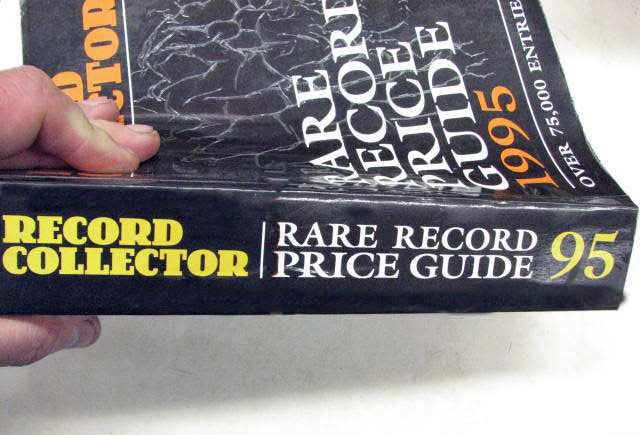
Of course, record shops need some point of reference when pricing their stock. Back in the day, pre-internet, it was Record Collector magazine’s Rare Record Price Guide, an increasingly weighty tome found beneath every secondhand record emporium counter. But as the world has become increasingly digitised, Discogs has succeeded it as the de facto, far quicker go-to, for stores and customers alike. In fact, it’s common, though often irritating to store owners and record fairers, for customers to check the in-store price against the Discogs median on their phones there and then. After all, it you can find it cheaper online, why pay top dollar in-store? And as I see it, herein lies a huge problem for secondhand record stores, particularly those whose racks are completely overstuffed with vinyl that hasn’t moved for weeks, even months : if you’re overpricing, you’re not selling.
There are few bargains to be had anymore. Even charity shops have become savvy to Discogs pricing, the larger ones employ (volunteer) vinyl specialists to filter out the wheat from the chaff, the Mrs Mills organ favourites from the obscure Drag City 7″‘s. The good stuff, invariably now under lock and key in a glass cabinet; worst still, sold off on Discogs, eBay or even at record fairs, for maximum profit and not in the shop at all. In the window of Oxfam a few weeks ago, an almost complete collection of Cocteau Twins CD singles, none of them less than £20 each. Those prices weren’t arrived at arbitrarily.
Recently, on my first visit to a tiny London record store, I chanced upon a near mint, vinyl copy of Harold Budd’s ‘Abandoned Cities,’ from 1984, on his own Cantil label. Being a big fan of Budd’s output (there’s no such thing as a bad Harold Budd album, if you ask me), I gently set it aside for a moment, so that I could gauge (yes, on Discogs) whether the £60 price tag was, as I suspected, a little on the high side. Discogs informed me that, although 898 of its users owned the record, 1480 others wanted it. That immediately gave me some indication of its scarcity. There were just 8 copies available for sale, worldwide, only one of those located in the UK and priced at £65 plus shipping (and Discogs fees). Even so, the median price for the record was £32.63 and the highest it had ever sold for on Discogs was £84.09. Interestingly, this particular store had most likely dismissed the Discogs median price in favour of a price very close to the one UK copy available, only very slightly undercutting it. But how long had it been there? And if I hadn’t walked in, how long would it have stayed there? As it turned out, having bought several records in this particular store, I was granted an £8 discount on the Budd. So, £52 for an album that was, by the way, re-issued on All Saints in 2013 (Discogs highest price, £60; median £18.49). Did I need an original 1984 copy of it? No, but given that I’d never seen either version in the wild, I made the impulsive decision to snap it up.
So, evidently, despite the high pricing, this stuff does sell, no? Well, sometimes but more often than not, at these prices, it’s completely dependent on the right person coming into the shop – that being a hardcore fan/collector of that particular artist, with money burning a hole in his/her pocket and unless your record shop is in a fairly well-heeled area, with lots of footfall, you may be waiting a while before taking that first edition Vashti Bunyan album off the wall.
I visit a lot of record shops in small towns, up and down the country and can’t help but wonder how they survive. It’s not that the stock is bad (though, in very rare cases, it is dire), it’s that there’s little understanding of how much disposable income the people in that area actually have. Those £5 copies of ‘Brothers In Arms’ and ‘No Parlez’ surely aren’t paying the rent? That £150 album on the wall is waiting for a one-in-a-thousand customer. And by this logic, if it were half that price, perhaps one-in-five hundred customers might consider buying it? It’s evident that prices are out of control and referencing Discogs as a benchmark, isn’t doing stores or customers any favours. How much is a vinyl album actually worth? That question is for another day. Today’s question is : if record stores did away with Discogs pricing, would they actually sell a lot more records? And if so, why aren’t they doing it?
If you’re a record store owner, sticking to Discogs pricing, your top line (your most expensive records) is only ever going to be affordable to a small percentage of the population. Those records on your walls aren’t paying your rent, encouraging more customers through the door or doing anything to burst the Discogs bubble. It’s high time we, collectively, took a step back and considered whether the future of record collecting is elitist privilege.

 Arcane Delights